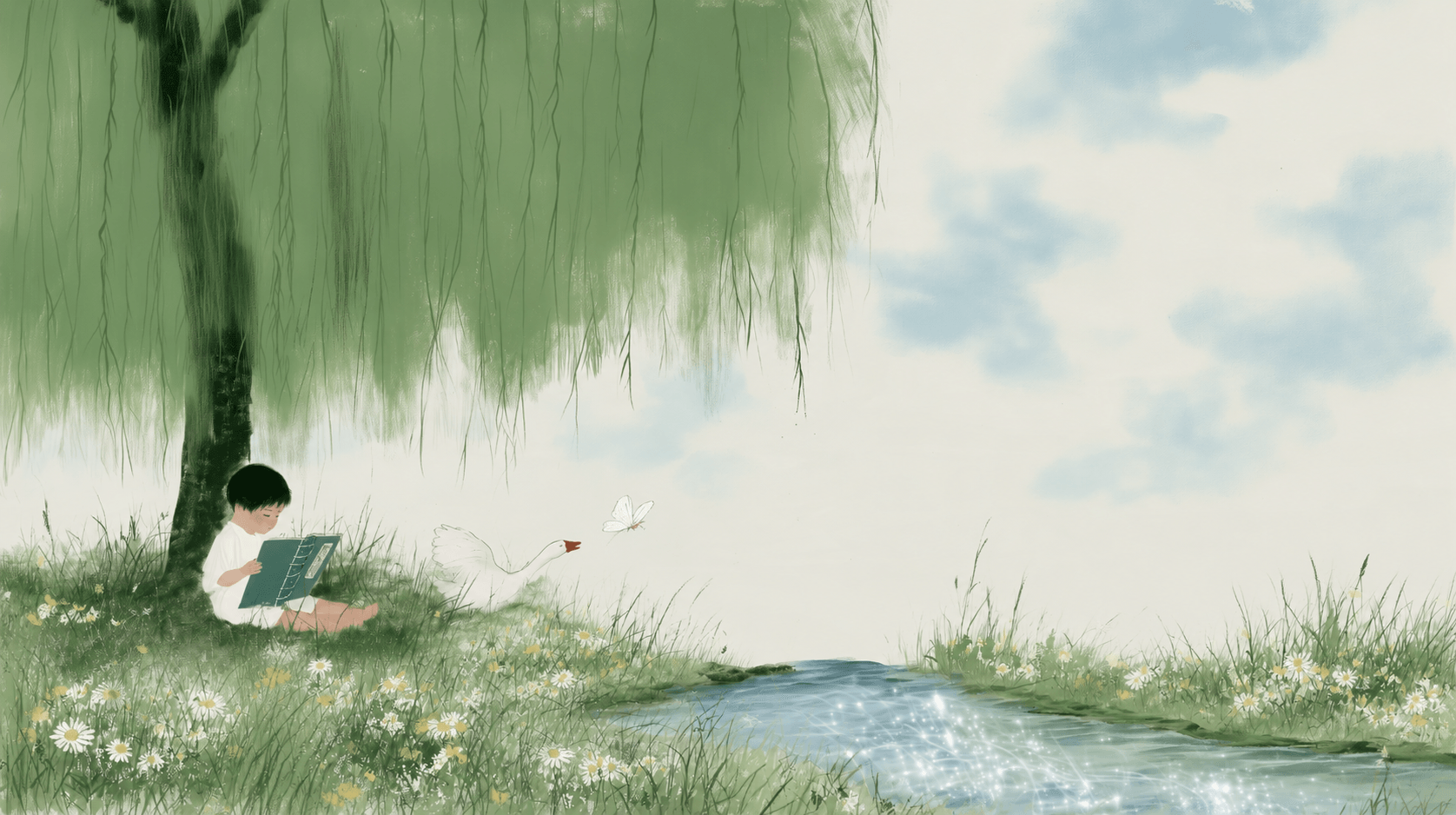
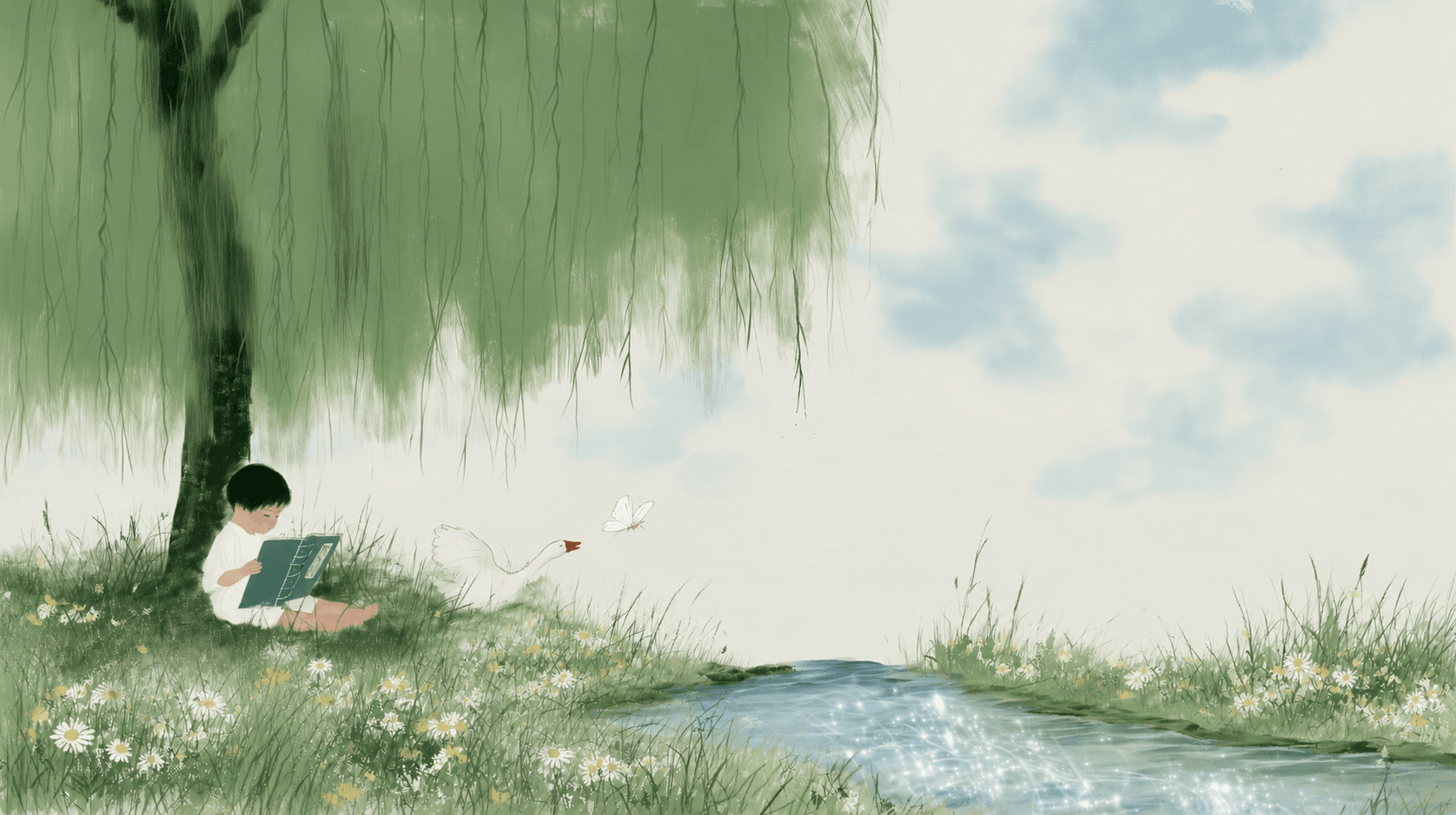
A child reading under a weeping willow while a white goose watches a butterfly beside a stream
Goose Chinese

Early testing begins spring 2027

Mandarin, from first sounds to reading.

Goose Chinese takes overseas Chinese children from age two through listening, speaking, and pinyin, and on to a thousand characters. It assumes nothing: not English, not a fluent parent, not even which way the words go.

Early testing begins spring 2027. For early testers, not the finished app.

第一課Lesson one · Why

Chinese is easy. Memorizing characters is not.

You have seen what is out there. Ugly, cheesy visuals. Stories no adult would read twice. Scenarios a child abroad will never meet. A single Beijing accent presented as the only Chinese. Streaks and points to keep you opening the app. And underneath it all, the same assumption: that learning Chinese means memorizing characters, and that not much can happen until you have.

We think that premise is wrong. The language itself is approachable; the characters are the blocker. So Goose Chinese separates the two and lets the language come first, with a standard of craft you would be glad to leave open on the kitchen table.

  • No streaks, no points.We don't manufacture urgency. A child comes back because the goose is there, not because a counter is about to reset.
  • No cheese.Hand-painted scenes, real sound, and stories worth hearing twice. Nothing flashes, nothing shouts, nothing nags.
  • No assumptions.Not English, not a fluent parent, not that text runs left to right. We start where a two-year-old actually is.
第二課Lesson two · Method

Read first. Memorize later, if at all.

Most programs gate reading behind character memorization, so children read almost nothing for years. Goose Chinese decouples the two. Children read real stories and dialogue in pinyin early and often, building vocabulary, grammar, and fluency. Characters are introduced progressively, on top of language the child already has.

“Don’t stop yourself from reading more Chinese just because you don’t know the characters. You can get surprisingly far with pinyin alone.”

  1. 一

    Listen first.

    Everything begins with the ear. Children hear the sounds of Mandarin, clean and unhurried, long before anyone asks them to read a thing.

  2. 二

    Then speak, and speak correctly.

    We care about each phoneme from the very first attempt: the retroflex zh, the aspirated p, the ü that English does not have. Early habits are the hardest to unlearn, so we form the right ones early.

  3. 三

    Tones, pitch-perfect.

    Not roughly right. Each tone is drawn as a path a child can trace with a finger and follow with a voice, until the rise and the fall are simply how the word is said.

    māmother
    The four Mandarin tones drawn as contours: level, rising, dipping, falling.
  4. 四

    Read in pinyin, early and often.

    Pinyin is a full reading system, not a crutch. We teach it from zero — the letters, their sounds, the fact that words run left to right — and then children read with it: stories, dialogue, the things they want to say. Vocabulary, grammar, and a feel for the language arrive years before they otherwise would. Pinyin rather than zhuyin, deliberately.

    我Wǒ的de鳥niǎo會huì說shuō中文。Zhōngwén.
    “My bird can speak Chinese.” Read in pinyin first; the characters come after, as labels for words already known.
  5. 五

    Characters, on top of language the child already has.

    Once a word is spoken, read, and understood, its character is a label for something known rather than a shape to memorize. Characters are introduced progressively, toward a thousand and beyond, in traditional or simplified. The child chooses.

第三課Lesson three · A lesson

What a lesson is like.

第四課Lesson four · Taste
我鳥中文 — the Goose Chinese mark in vermilion

Taste is the product.

We took our cues from the 國語課本 of a century ago: ink and vermilion on cream paper, generous margins, one lesson to a page, line drawings of children, animals, and ordinary days. Those primers taught a generation to read without a single notification.

Goose Chinese borrows that restraint. One idea per screen. A hand-painted scene rather than a sticker sheet. Chinese set in the Ministry of Education’s standard Kai, with the same care as the English beside it. Nothing bounces for attention, because nothing has to.

The goose is the whimsy. Everything around it is the quiet paper it stands on.

中我文鳥

Our name in Chinese is 我鳥中文 — roughly, “my bird’s Chinese.” The bird is a goose. It is a little stubborn, and so are we.

第五課Lesson five · A letter

Why I am building this

I am Taiwanese, I grew up in China, and I live overseas. Our first child, a boy, is due in January. I have been looking for a complete Chinese program I would want him to use, and I have not found one.

My husband is French. He has tried to learn Chinese for years, and beyond private tutors, which are expensive and never quite consistent enough, there has been little to help him. Language is a daily task. It needs something that is there every day.

I want our son to talk with my parents, to sound natural, and to catch the references a culture speaks in: the 成語. Whether he can write characters by hand matters much less to me.

Enle, founder

第六課Lesson six · For parents

The practical page.

You are probably busy, possibly not fluent yourself, and likely tired of apps that promise the moon. Here is what Goose Chinese is, plainly.

Age
From two or three, with no upper bound. The goal is literacy: a thousand characters and more, from first sounds to reading.
Your part
You do not need to speak Chinese. The child learns on their own, or with you alongside, supervising rather than teaching. Mixed and heritage families are the point, not an edge case.
Script
Traditional and simplified are both taught; the child chooses. Reading begins in pinyin, not zhuyin, and characters follow.
Voice
The standard Mandarin of 1980s Taiwanese television: a light Taiwanese accent, clear and unhurried. A deliberate choice.
Priorities
Listening, speaking, reading, natural-sounding fluency, and in time the cultural literacy of 成語. Writing characters by hand is not one of them.
Where
iPad and the web. The same lessons, the same progress, whichever is nearer to hand.
Price
A premium subscription, billed monthly. Priced for families who want it done properly.
Status
In development. Early testing begins spring 2027; join the early testing list and we will write when there is something worth putting in front of your child.

Early testing

Be among the first to try it.

Early testing begins spring 2027, on iPad and web. This is a list for early internal testing, not the finished app. Leave your email and we will write once when there is something to try, and rarely otherwise.

Early testing begins spring 2027. For early testers, not the finished app.